
week 121

jazz.computer is a favorite thing.

– In the terrible world of humans that we live in, remember that there are whales, and that they’re beautiful.

– Google keep knocking things out of the park:  Soli appears to be the answer to many an interface designer’s wildest dreams.

– Started Warren Ellis’s INJECTION, and am excited to keep up with it.

– Read and finished Octavia E. Butler’s KINDRED, which is heartrending and amazing.

week nine billion

Lots to catch up on.

– The US Navy once built a research boat that is designed to rotate 90 degrees into the water.

Enclaves within enclaves, between Belgium and The Netherlands.

– Fuck the NSA – and this is funny.

– Sony hate music, may prevent Beyonce from being on Tidal.

– I’ve been a fan of Luisa Pereira for a while, but seeing her talk at a Monthly Music Hackathon only made me like her work more.

– Super nice conductive thread / wearable interfaces via Project Jacquard.

Ableton Push Hero, via my friend / black magician Nathan.

– Saw FURY ROAD – it deserves every bit of praise it is getting.

Destroying objects as soundscapes.

– The Segulharp is maybe a bit pat, but really nice.  As someone who knows a lot about digital interfaces for making music,  real acoustics thing are pretty good.

– Along those lines, this monster is neat:  the interface is willfully bad, which makes the performance even more impressive – look at 2:02 or so, where he rotates the pad just because he can.

A Twine “interactive fiction” thing is finally blowing up – on the Apple Watch, no less.

Typedrummer is the most basic thing, but works really well.  It’s a drum machine with the drum machine elided away, which is something that has been on my mind for a minute.

co.re.echo.es

I have a sort of casual fascination with infrastructure – factories, power stations, spillways, and so on.  This extends to the internet:  data centres, underwater cables, and core routers.

“Core router” is not just a perfectly Gibsonian term – they’re the routers that most data runs through when going from place to place and network to network.  And seeing this is not hard, though it is picky:  the traceroute command will tell you where you went to get to a place.

You can thus, if you really want to, trace from your computer to all (actually only most) 4,294,967,296 address, from 0.0.0.0 to 255.255.255.255.  This will mean that your computer will go through those core routers over and over and over again.

So, I made a thing that does this, and then turns those traceroutes into music, as one does.  It is called CORE ECHOES, after those routers,  and it is both pretty mellow and suspiciously good, if I do say so myself.  It will also play for something like eight thousand years.  (And!  There’s now a recorded version here.  )

In order to make a thing play for longer than the human race has had writing, I’m relying very much on AWS and Heroku, which will for sure both be around for another few thousand years.  Specifically, I have a process on AWS that is slowly sending out traces, and then logging them to a Redis queue on Heroku.  Heroku then acts as web server, returning the current trace to the JavaScript client.

There’s a timing concern, too:  there’s a second process on AWS that keeps track of how long each trace should play for, and then turns the page of the piece by removing the current trace from the queue.

This has about a million race conditions – but they’re very slow race conditions, so things will probably be OK.  In theory, a series of very short traces could run the queue out of data before a next very long trace can log…but that is a risk I am prepared to take.
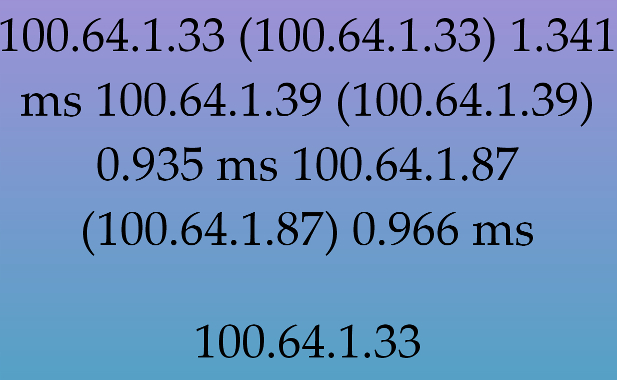
core-echoes-0

All the mapping and synthesis is handled in JavaScript – really, the mapping should happen on the server side, and the client should only do the synthesis, but c’est la vie.  The synthesis is all in WebAudio – there are three sine waves, each with their own pretty-simple signal chain.  I was trying to both do something simple and backgroundy, and get a sense of bleeps and bits and ones and zeroes moving around.

Each IP generates a single pitch, a duration that it runs for, a time between notes, and the length of each note.  This gives an ever-changing minimalist sort of pulse, as the three IPs build up and vary.

The duration is deterministic:  take the sum of the digits of the first three parts of the IP, then divide by four to get a nice sort of time.  The other parameters work in the same manner.  The pitch is taken mod 24, and so on.

The mapping was initially much more complex, but it turns out that there are a lot of IPs, so making them deterministic is probably OK.  An obvious mapping improvements would be to relate the time for each IP to match the time that the trace takes – but that gets into tricky regex issues.  I’m happy with the synthesis, though I am sure that I will regret not making the server more robust.


week 119

– Glenn McDonald knocks it out of the park again with the words for each genre, and vice versa.

“Just” being a DJ is ok.  Articulated very well by Philip Sherburne.

Bespoke small-run vinyl, via qrates.  Super interesting, this.

Norse is a security company that likes War-Games-esq attack visualizations…which are cheesy, but also amazing.

week 118

Early, but.

Reynald Drouhin is a new favorite thing.

Modular synths meet robotic instruments.  Having seen a bunch of this in academic settings, it will be neat to let it out in the wild.

Theorizing The Web was beyond excellent.  Some highlights included Nick Seaver on recommendation systems, Natalie Kane on algorithms & haunting, Nick Douglas’ “It’s Supposed To Look Like Shit” talk, and many more.

– Finally listening to the symphonic jams of both Ellington and William Grant Still.  So much to hear, so much to learn.

week 117

So many things!

StaffPad actually has potential to drastically change how most composers write music.  It, of course, needs to get off the Surface, and allow freeform input, and they’ll be golden.

Hopes & Fears is a new fave, and this Jonathan Lethem interview is one of the reasons why.

– Of course Ben ‘Processing’ Fry is the person behind these code maps.

– Ingrid Burrington is also a new favorite, not least for her amazing URL:  http://lifewinning.com

– Burrington also spoke at Future Everything 2015, along with Warren Ellis, etc.

– Never hurts to be reminded of Limits To Growth, as referenced from MoMa’s Uneven Growth.

week 116

Let’s talk about NI’s STEMS.

This is super interesting, not least because it is an open, backwards-compatible format.  It’s also worth noting that this idea has been around for ages – your very own Tide Pool netlabel was selling parts, oh, almost a decade ago, now, among several others.

What’s hip here is the instant integration into NI’s line of DJing controllers, and into their idea of a ‘Remix Deck’.  Suddenly, the “live remix” that people have been talking about for, oh, a decade (actually since the dawn of DJing) is ‘way easier.

This has lots of potential to be very cool – especially as that four tracks becomes eight and then 16.

This also has potential to be nasty, in a way that I’ve been trying to articulate since Sasha switched to Ableton in 2004 or so:  The danger of giving DJs full control over the music that they are playing is that it all sounds like them.

Consider myself:  I love the long mix.  I came up on John Digweed and early 2000s progressive house, and if you can hear a transition, by god, you’ve failed.  This is a noble goal, but it sure can make for boring sets.  If I had the power to loop out every tune, I’d for sure make each mix as smoooooooth as possible – probably to my detriment.

On the other hand, if I’m Just Playing Records, I am stuck with the arrangement of those records, and have to make do.  This makes me work harder, and makes my DJ sets way way way more interesting.

The future that NI is pushing is of a middle-road between “putting on records in a row” and “permuting those records in compelling ways”.  I don’t think the tools for NI’s vision are there yet (although that tool, still, might be Ableton), though I am sort of excited to see where that future goes.  But, don’t forget about the other paradigm:  David Mancuso and the idea of “letting the record speak” still have a lot of miles to go.

week 115

week 110.5

Snowden, Poitras, and Greenwald did an AMA.  Essential.  My TOR node is up:  is yours?

– Charles Stross is on depressingly good form here, I think.

– I knew about Eno’s Oblique Strategies, but I did not know that my man Marshall McLuhan had his own version:  The Distant Early Warning.

week 109

So, I moved to New York.  It’s been, as they say, real.

Amazing intro / discussion of African science fiction.

BBC Kraftwerk doc.

– You can execute arbitrary code in Super Mario World.  I mean, honestly.

 Crash Override is important.

Tahir Hemphill is also pretty important.

Let biometric feedback manage your friendships.  No, really.